


Guest post by Amber Ramsey
Data-driven companies consistently outperform their peers. Whether it’s improving efficiency, optimizing pricing, or uncovering new opportunities, integrating data analytics into operations and strategy gives businesses the ability to move faster, adapt smarter, and make decisions grounded in reality, not guesswork.
Key Insights

Where Integration Begins
Many organizations begin with dashboards and reports but fail to evolve into predictive and prescriptive analytics. To progress, companies must treat data as an asset, one that touches marketing, finance, supply chain, and customer experience. This shift changes how leaders plan and execute growth.
Use Analytics to Enhance Operations
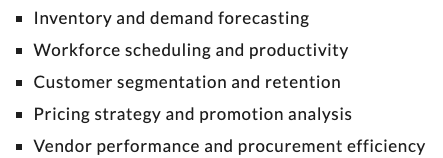
Operational analytics identifies inefficiencies and areas where automation or smarter forecasting can save time and money. For instance, analyzing customer behavior patterns may reveal which product lines drive repeat purchases, while logistics data might expose bottlenecks in delivery processes. Here’s a look at common operational areas that benefit from analytics:
Turn Data Into Strategy
Strategic integration is where analytics becomes transformative. Leaders use scenario modeling and trend forecasting to build resilient plans. A business that understands its customer lifecycle and real-time financial data can pivot more effectively in volatile markets.
When analytics is part of the strategic rhythm, insights move from quarterly reviews to continuous improvement loops.
How to Integrate Data Analytics Successfully
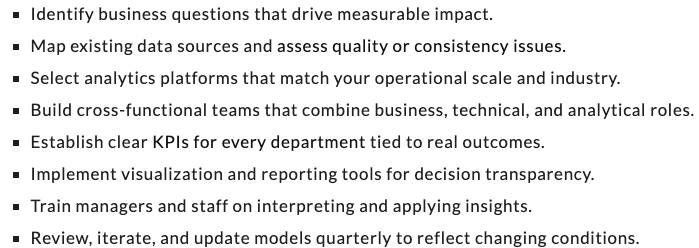
To make data analytics work across departments, companies must build a process that balances technology, people, and decision frameworks. Follow this implementation checklist to structure integration effectively.
The Role of Real-Time Data Intelligence at the Edge
Some industries—especially manufacturing, logistics, and utilities—are beginning to process data directly where it’s created to make faster, more localized decisions. This approach, known as data intelligence edge computing, enables immediate analysis of equipment, supply, or sensor data without relying solely on the cloud. By capturing insights closer to their source, companies reduce downtime, improve efficiency, and unlock value from previously underused systems.
Measuring Success Through Data
Once analytics are embedded, businesses should evaluate progress across measurable categories. The following overview shows how to align key objectives with their data-driven benefits.
| Objective | Analytics Application | Business Outcome |
| Improve efficiency | Process automation & workflow analytics | Reduced operational costs |
| Increase revenue | Customer segmentation & lifetime value modeling | Higher sales and retention |
| Strengthen strategy | Predictive modeling & scenario testing | Faster, evidence-based decisions |
| Enhance customer experience | Sentiment and behavior analytics | Increased loyalty and satisfaction |
| Mitigate risk | Fraud detection & anomaly monitoring | Lower exposure and financial loss |
Practical Benefits of a Data-First Culture
Before analytics can drive growth, the organization must trust and rely on it. That means leaders promote a culture where decisions are debated with evidence, not opinions. Over time, this approach compounds advantages: better forecasting, fewer errors, and stronger accountability across all levels.
Why Businesses Resist and How to Overcome It
Resistance often stems from misunderstanding or fear of data complexity. Start small: pick one critical process and measure improvement. Prove value through quick wins before scaling. When teams see success, data becomes a shared ally rather than an abstract IT initiative.
FAQ
How much data do I actually need to start?
Not as much as you think. Start with existing sales, operations, or customer data. The goal isn’t size, it’s relevance and reliability. As your systems mature, you can layer in external sources, IoT streams, or market data for richer insights.
What’s the biggest mistake companies make when using analytics?
Many businesses collect data without a clear question in mind. Without purpose, analytics becomes noise. Always tie analysis to a business decision—pricing, inventory, or growth planning—to generate actionable insight and ROI.
Should analytics be managed internally or outsourced?
It depends on capability and scale. Small businesses can start with external partners or SaaS platforms to establish frameworks. As reliance grows, investing in internal analytics talent ensures a deeper understanding and faster iteration cycles.
How do I ensure employees use data effectively?
Training and access are crucial. Equip teams with intuitive dashboards and create rituals—weekly data reviews or insight discussions—that make analytics part of the daily rhythm. Over time, data-driven habits replace intuition-driven decisions.
Can analytics help in uncertain markets?
Absolutely. Predictive analytics models can simulate potential outcomes, helping leaders allocate resources strategically. During volatility, this ability to model “what if” scenarios gives companies confidence to act decisively instead of reactively.
What role does leadership play in data integration?
Leadership sets the tone. Executives must champion transparency, reward data-informed decisions, and model accountability through evidence-based planning. When leaders rely on insights, teams follow suit.
Build Momentum
When businesses fuse data analytics into every layer of their operations and strategy, they evolve from reactive management to proactive leadership. The shift requires consistency and commitment, but once achieved, it becomes a growth engine that compounds insight and performance over time.
Conclusion
Data analytics is no longer optional, it’s the operating system for modern business. Companies that build this capability now will make faster, smarter decisions and outperform those still relying on intuition. Start small, stay consistent, and let insight guide every move; the future belongs to the businesses that measure what matters.
Photo by fauxels.




Leave a Reply
Your email is safe with us.